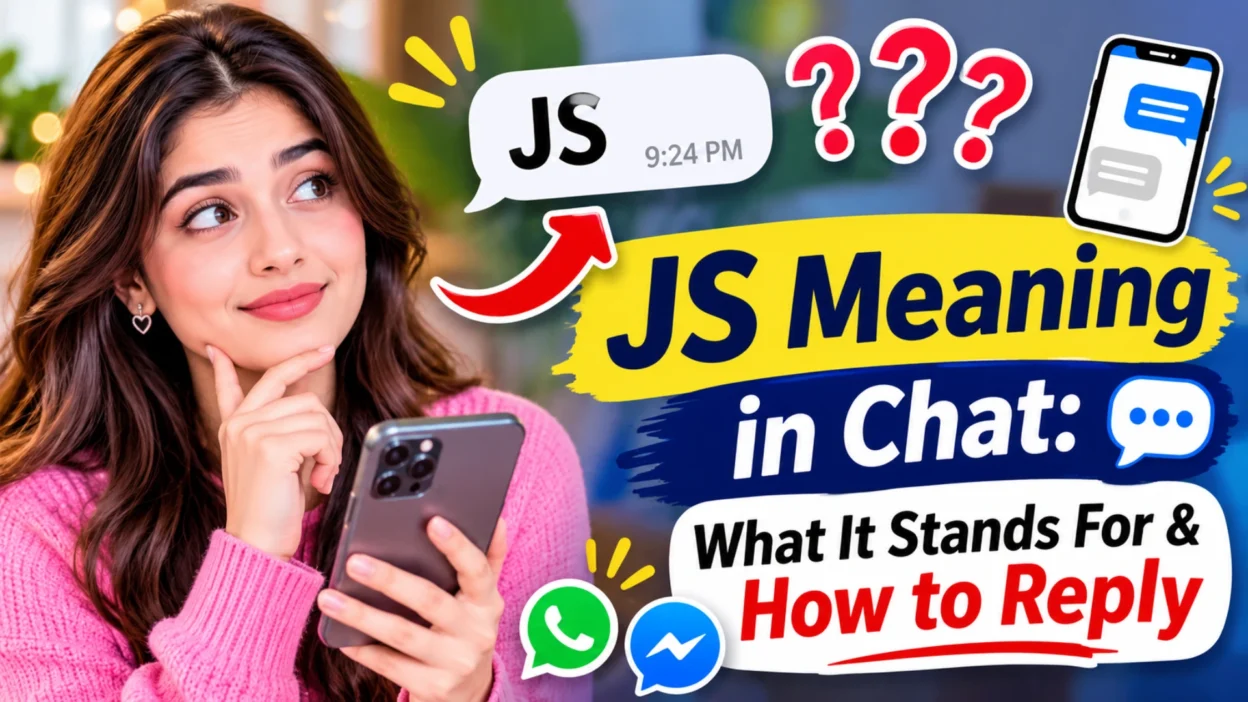
You’re in the middle of a conversation—maybe a group chat, a DM, or a comment thread—and someone drops “js” at the end of a sentence. The message makes sense, but those two letters don’t. You reread the line and wonder if you missed something obvious.
You didn’t. In nearly every casual chat context, JS stands for “just saying” . It’s one of the most common abbreviations in texting, and it does a very specific job: it softens whatever comes before it. But like most slang, its meaning depends heavily on tone, placement, and who sent it.
This guide breaks down what JS means in chat, how people actually use it, when it backfires, and how to reply when you’re not sure what someone meant.
📖 The Core Meaning: “Just Saying”
JS is shorthand for “just saying” (or “just sayin'”). It appears at the end of a statement—usually an opinion, a piece of advice, or an observation that might land a little too bluntly without a cushion .
The phrase itself is older than texting. The defensive “I’m just saying” shows up in novels as far back as the 1930s. The catchphrase version gained popularity in the 1990s through comedians, and by 2011 it had landed on a university’s list of banished words—a sign it had been used to death . The two-letter abbreviation came later, born from the character limits of early text messages and instant messaging .
When someone types “js,” they’re doing what people do in speech: adding a verbal shrug. It says, “I’m putting this out there, but I’m not trying to start a fight.” For more you may like to read hm mean in text.
🎯 What JS Actually Does to a Message
The letters themselves are neutral. The work they do depends on the sentence before them.
It softens criticism. A blunt statement feels less like an attack when JS follows it. “That outfit was a bit much, js” lands differently than “That outfit was a bit much” .
It adds deniability. If the other person reacts badly, JS gives the sender an out. They can claim they weren’t trying to start anything—they were just saying .
It signals casualness. It tells the reader not to overanalyze the message. It’s a passing thought, not a declaration.
It can preempt conflict. It’s a small verbal white flag raised before the message even lands .
Here’s the catch: JS doesn’t always work as intended. Depending on the existing tension between two people and the tone of the words before it, “js” can come across as passive-aggressive rather than genuinely casual. Think of it like “no offense”—a phrase that rarely makes what follows land any softer .
💬 JS in Real Conversations
Seeing JS in context makes its function clear.
In a Private Chat
Person A: “You’ve been quiet lately.”
Person B: “Idk just feels like you’ve been busy with other people js”
Here, JS softens what could read as an accusation. It turns a pointed observation into something closer to a passing thought .
In an Instagram DM
Person A: “That outfit from yesterday was fire 🔥”
Person B: “Thank you!! though the shoes were a bit much lol”
Person A: “Nah they worked, js you should wear them more often”
In this exchange, JS is playful. It’s more encouragement than critique .
In a TikTok Comment
“The editing on this video was kinda choppy in the middle, js 🎬”
Comment sections are where JS shows up constantly. Public criticism needs some kind of cushion, and dropping “js” at the end of a critical comment reads as less confrontational than leaving the opinion bare .
⚠️ The Trap: When JS Reads as Passive-Aggressive
JS is supposed to soften. Sometimes it does the opposite.
If the sentence before it is already sharp, adding “js” doesn’t neutralize it—it makes it feel like a jab with a fake smile. “You did leave the group chat on read for three days, js” is not an apology. It’s a pointed remark with a disclaimer attached .
The tone depends on three things:
The sentence before it. A gentle observation stays gentle with JS. A harsh statement gets harsher.
The relationship. Between close friends, JS is low-stakes filler. Between people with tension, it can read as a dig.
The punctuation. A standalone “js” with no follow-up can feel cold. “Js” inside a longer, warmer message feels casual .
If you’re on the receiving end of a JS that feels passive-aggressive, trust that instinct. The letters don’t change the meaning of the words before them.
🆚 JS vs. JK: A Key Difference
People sometimes confuse JS with JK, which stands for “just kidding.” They look similar and occupy the same casual texting space, but they do opposite things.
JK takes a statement back. “You’re wrong, jk” means “I didn’t mean that.”
JS stands by the statement. “You’re wrong, js” means “I meant that, but I’m trying not to make a big deal of it” .
If you want to retract something, use JK. If you want to soften something you actually mean, use JS.
📱 JS on Different Platforms
The core meaning stays the same, but the context shifts slightly.
WhatsApp: JS appears in one-on-one chats, often to soften advice or a personal opinion between friends or family .
Instagram: JS shows up in comments and DMs, often playfully or semi-sarcastically. “Cute pic, js you’re glowing” is a light compliment with a casual tag .
TikTok: Comment sections are fast and reaction-driven. JS tends to appear as a quick opinion tacked onto a comment, usually with a humorous edge .
Snapchat: Short, casual conversations. JS fits naturally into one-on-one chats where friends trade quick opinions .
🧠 The Other Meaning: “Just”
In fast, lowercase texting, “js” can also stand in for the plain word “just” .
The giveaway is its position. If “js” appears mid-sentence, it almost certainly means “just.”
“i js got home, gimme ten min and i’ll call u”
Here, “js” means “just.” “Just saying” makes no sense in this position. The sentence isn’t stating an opinion—it’s explaining a delay .
💻 The Tech Meaning: JavaScript
In coding and technology conversations, JS is the standard abbreviation for JavaScript, the programming language that powers interactive elements on websites .
If the conversation involves programming, web development, or files ending in “.js,” this is almost certainly what JS means. If a coworker in web development says “Need help with JS today,” they are not talking about “just saying.” They are talking about code .
❓ FAQs
What does JS mean in chat?
In most chat contexts, JS stands for “just saying.” It’s added to the end of an opinion or observation to soften it or signal that you’re not trying to start an argument .
Is JS rude?
Not inherently. It’s meant to soften a statement, but it can come across as passive-aggressive depending on the tone of the words before it and the relationship between the people chatting .
What does JS mean from a girl or guy?
The meaning doesn’t change based on gender. JS means the same thing regardless of who sends it. The context of the message determines the tone .
Does JS ever mean “just”?
Yes. In fast lowercase texting, “js” can be a shortened spelling of “just,” especially when it appears mid-sentence. “i js got here” means “I just got here” .
What does JS mean in coding?
In programming contexts, JS stands for JavaScript. If you see it in a conversation about web development or next to a “.js” file extension, that’s the meaning .
How do I reply to a JS message?
If the JS feels casual, reply normally. If it feels passive-aggressive, you can address the statement directly or ask for clarification. There’s no special response required—JS is just a conversational tag, not a question.
💡 Final Thoughts
JS is one of those abbreviations that seems trivial until you’re the one staring at it, unsure what someone meant. In almost every casual chat context, it means “just saying”—a two-letter cushion that softens an opinion and gives the sender room to back away if things get tense.
But context is everything. Mid-sentence, it might mean “just.” In a coding chat, it means JavaScript. And sometimes, despite the sender’s best intentions, it lands as passive-aggressive rather than casual. The letters stay the same; the meaning shifts with the conversation.
If you’re ever unsure, look at what comes before it. That’s where the real message lives.

Hamid Mehmood is a passionate content creator dedicated to making words, messages, and online expressions easy to understand. He enjoys creating clear, helpful content that helps readers discover meanings and communicate with confidence.