You’re scrolling through a group chat or reading a comment thread, and someone drops “js” at the end of a sentence. Maybe it’s tacked onto an opinion, a piece of advice, or a slightly awkward observation. You understand every word except those two letters, and suddenly the whole message feels like it’s missing context.
The answer is simpler than you might think. In most texting and social media conversations, JS stands for “just saying” . It’s a tiny abbreviation with a very specific job: it softens whatever comes before it. But like many pieces of internet slang, its meaning can shift depending on where it appears and what the conversation is about. This guide breaks down exactly what JS means, how people actually use it, and when it might mean something else entirely.
📖 What Does JS Stand For?
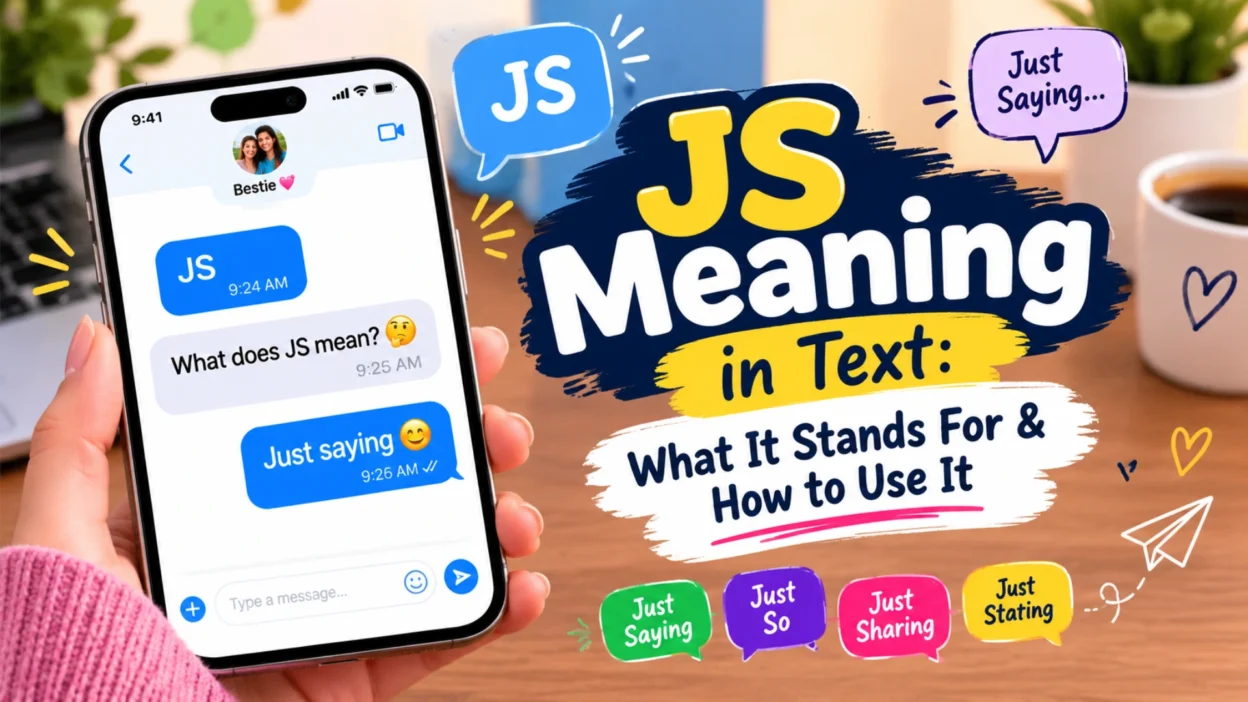
JS is an abbreviation for “just saying” . People use it in texting, online chat, instant messaging, and social media postings to add a casual disclaimer to an opinion or observation .
The phrase it shortens—”I’m just saying”—has been around for much longer than the abbreviation. The defensive “I’m just saying” appears in novels as far back as the 1930s. The catchphrase version, “just sayin’,” gained popularity in the 1990s through comedians like Eddie Murphy and Paul Reiser. By 2011, it had landed on a university’s list of banished words, which is usually a sign that a phrase has been used to death .
The two-letter spelling “js” arrived with instant messaging and texting. Urban Dictionary entries record it by 2007, and Dictionary.com added it to its acronym guide in 2018 . The abbreviation was born from the same practical pressure that created “brb,” “idk,” and “jk”—early text messages had character limits, and every letter counted .
🎯 What JS Actually Does in a Conversation
JS isn’t just a shorter way to type “just saying.” It performs a specific social function. When someone adds “js” to the end of a message, they’re usually trying to do one or more of the following :
Soften criticism. A blunt statement feels less like an attack when JS follows it. “That outfit was a bit much, js” lands differently than “That outfit was a bit much.”
Add deniability. If the other person reacts badly, JS gives the sender an easy out. They can claim they weren’t trying to start anything—they were just saying.
Signal casualness. It tells the reader not to read too deeply into the message. It’s a passing thought, not a declaration.
Preempt conflict. It’s a small verbal white flag, raised before the message even lands.
Here’s the catch: JS doesn’t always work as intended. Depending on the existing tension between two people and the tone of the words before it, “js” can come across as passive-aggressive rather than genuinely casual. Think of it like “no offense”—a phrase that rarely makes what follows land any softer .
💬 How JS Is Used in Real Conversations
Seeing JS in context makes its function clear. Here are examples of how it appears in different settings.
In a Text Message
Person A: “You’ve been quiet lately.”
Person B: “Idk just feels like you’ve been busy with other people js”
Here, JS softens what could read as an accusation. It turns a pointed observation into something closer to a passing thought .
In an Instagram DM
Person A: “That outfit from yesterday was fire 🔥”
Person B: “Thank you!! though the shoes were a bit much lol”
Person A: “Nah they worked, js you should wear them more often”
In this exchange, JS is used playfully. It’s more encouragement than critique .
In a TikTok Comment
“The editing on this video was kinda choppy in the middle, js 🎬”
Comment sections are where JS shows up constantly. Public criticism needs some kind of cushion, and dropping “js” at the end of a critical comment reads as less confrontational than leaving the opinion bare .
⚠️ The Two Other Meanings of JS
“Just saying” is the dominant meaning in casual texting, but it’s not the only one. JS has two other common interpretations, and context is the only way to tell them apart.
JS as “Just”
In fast, lowercase texting, “js” can also stand in for the plain word “just” . The giveaway is its position in the sentence. If “js” appears mid-sentence, it almost certainly means “just.”
“i js got home, gimme ten min and i’ll call u”
Here, “js” means “just.” “Just saying” makes no sense in this position. The sentence isn’t stating an opinion—it’s explaining a delay .
JS as JavaScript
In coding and technology conversations, JS is the standard abbreviation for JavaScript, the programming language that powers interactive elements on websites . If the conversation involves programming, web development, or files ending in “.js,” this is almost certainly what JS means.
This meaning has nothing to do with texting slang. The two uses of the same letters are completely separate .
🚩 JS vs. JK: A Key Difference
People often confuse JS with JK, which stands for “just kidding.” They look similar and occupy the same casual texting space, but they do opposite things.
JK takes a statement back. “You’re wrong, jk” means “I didn’t mean that.”
JS stands by the statement. “You’re wrong, js” means “I meant that, but I’m trying not to make a big deal of it” .
If you want to retract something, use JK. If you want to soften something you actually mean, use JS.
📱 JS on Different Platforms
The core meaning of JS stays consistent across platforms, but the context shifts slightly.
TikTok comment sections are fast-moving and reaction-driven. JS tends to appear as a quick opinion tacked onto a comment, usually with a humorous edge .
Snapchat conversations are short and casual by design. JS fits naturally into one-on-one chats where friends trade quick opinions or light teasing .
WhatsApp and Instagram DMs are where JS shows up in its most conversational form—softening observations between friends, adding a casual disclaimer to advice, or keeping a critique from landing too hard .
❓ FAQs
What does JS mean in texting?
In most texting conversations, JS stands for “just saying.” It’s added to the end of an opinion or observation to soften it or signal that you’re not trying to start an argument .
Is JS the same as “just saying”?
Yes. JS is simply the abbreviated form. Spelling out “just saying” feels more deliberate, while “js” feels more offhand—which is usually the point .
What does JS mean on TikTok or Snapchat?
It still means “just saying.” On TikTok, it often appears in comments as a way to cushion a critical or humorous opinion. On Snapchat, it’s common in casual one-on-one chats .
Does JS ever mean “just”?
Yes. In fast lowercase texting, “js” can be a shortened spelling of “just,” especially when it appears mid-sentence. “i js got here” means “I just got here” .
What does JS mean in coding?
In programming contexts, JS stands for JavaScript. If you see it in a conversation about web development or next to a “.js” file extension, that’s the meaning .
Is JS rude?
Not inherently. It’s meant to soften a statement, but it can come across as passive-aggressive depending on the tone of the words before it and the relationship between the people texting .
Should I use JS in a work email?
No. JS is strictly informal. In professional settings, write out “just saying” or skip the disclaimer entirely .
💡 Final Thoughts
JS is one of those abbreviations that seems trivial until you’re the one staring at it, unsure what someone meant. In almost every casual texting context, it means “just saying”—a small, two-letter cushion that softens an opinion and gives the sender room to back away if things get tense.
But context is everything. Mid-sentence, it might mean “just.” In a coding chat, it means JavaScript. And sometimes, despite the sender’s best intentions, it lands as passive-aggressive rather than casual. The letters stay the same; the meaning shifts with the conversation.
If you’re ever unsure, look at what comes before it. That’s where the real message lives.

Hamid Mehmood is a passionate content creator dedicated to making words, messages, and online expressions easy to understand. He enjoys creating clear, helpful content that helps readers discover meanings and communicate with confidence.