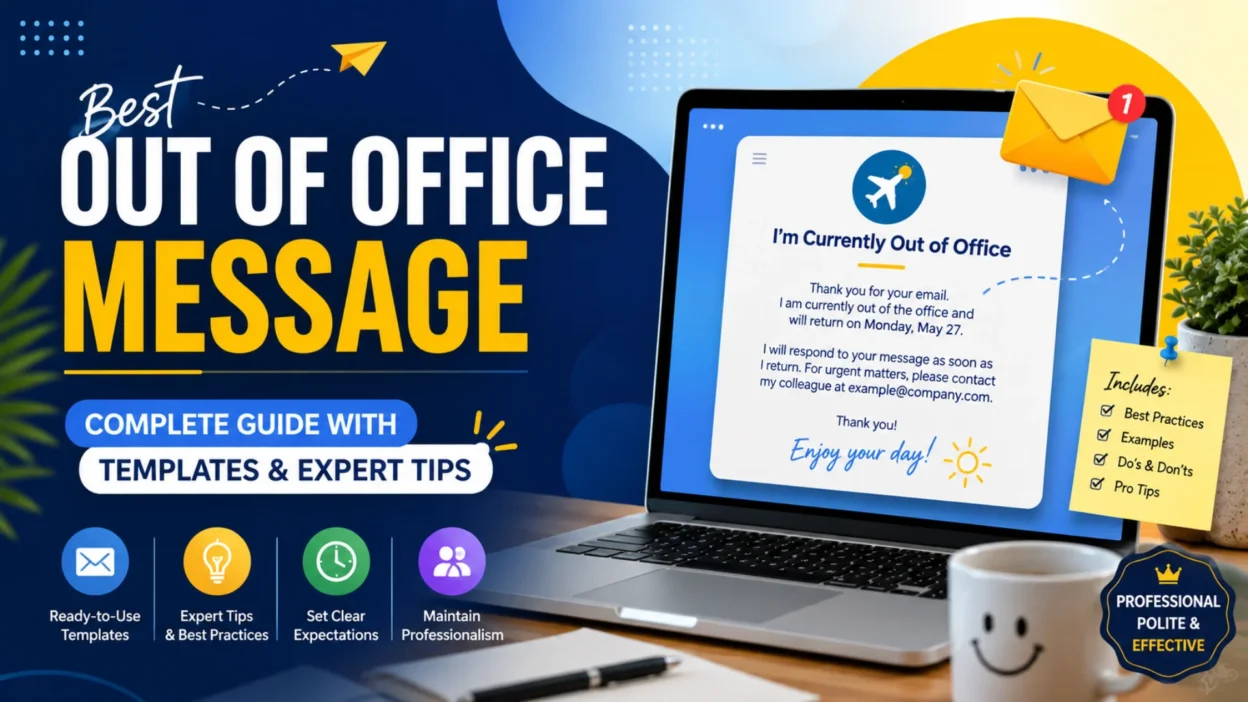
You’re finally about to log off for a well-earned break, but there’s one more task to tick off your to-do list: composing the perfect out-of-office message. Many of us are all too familiar with debating how much information to include, how available to say we’ll be, and whether to inject some personality or risk cracking a joke .
Getting this right matters more than you might think. A well-crafted message manages expectations, protects your boundaries, directs people to the right colleague, and preserves your sanity when you return . This guide provides everything you need to write the best out-of-office message for any situation, from vacation and sick days to professional conferences.
What Makes the Best Out-of-Office Message?
The best out-of-office messages share a common structure: they’re polite, concise, give a specific return date, and provide another point of contact if appropriate . Beyond these essentials, a truly effective message does two important things: it shares your dates and points people to a backup contact . This clarity prevents unnecessary follow-up emails and ensures important matters are handled while you’re away.
A vague or confusing out-of-office message is the email equivalent of a shrug. It creates extra work for everyone, leaving people uncertain about when to expect a reply or who else can help . That uncertainty is what leads to the “just-in-case” follow-ups that clutter your inbox when you return .
Essential Elements Every OOO Message Should Include
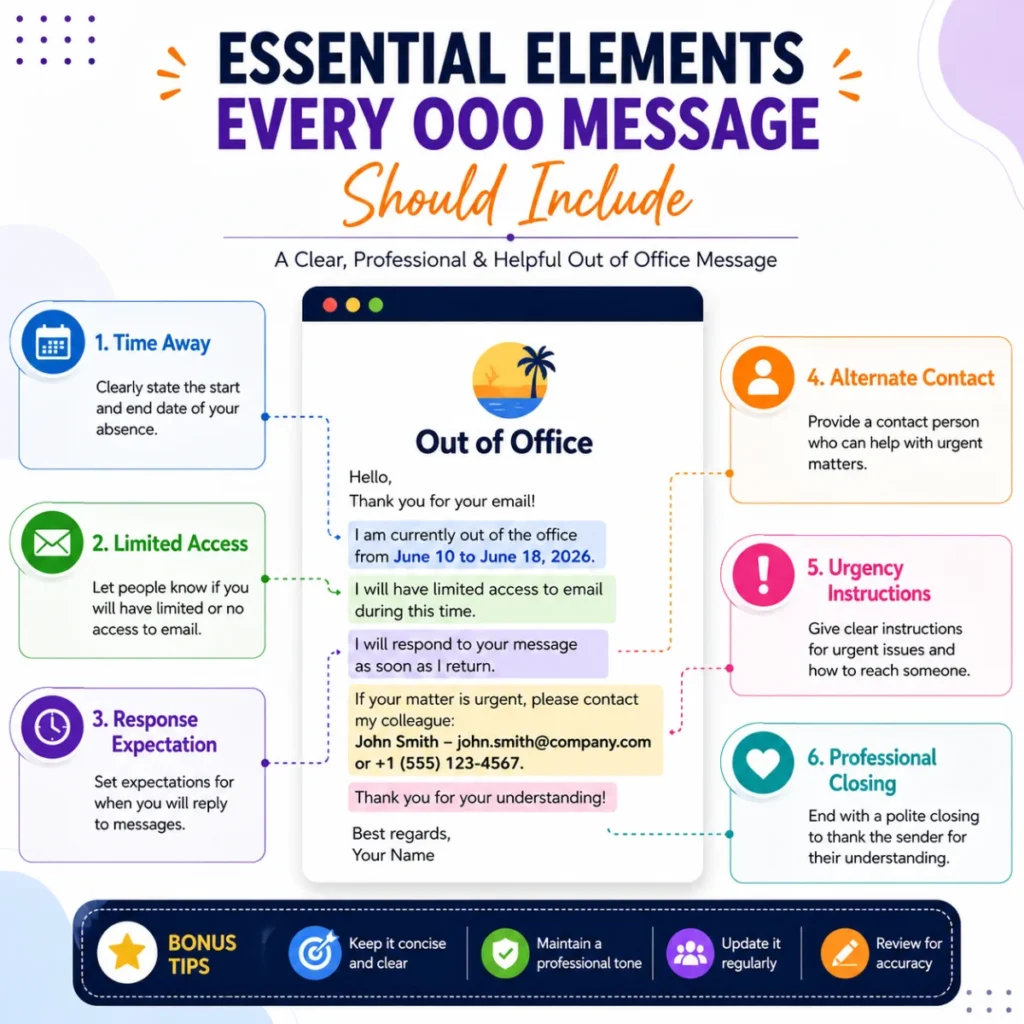
According to communication experts, every professional out-of-office email should include the following checklist of details :
- Subject line: State that you’re out of office, including the dates
- Greeting: Begin with a succinct and polite opener
- Duration of leave: Alert the recipient to your absence, including your return date
- Reply expectations: Mention if you’ll be checking emails periodically
- Alternate contact: Provide another point of contact (with their prior approval)
- Email signature: Include your title, company, and contact information
Best Out-of-Office Message Templates for Every Situation
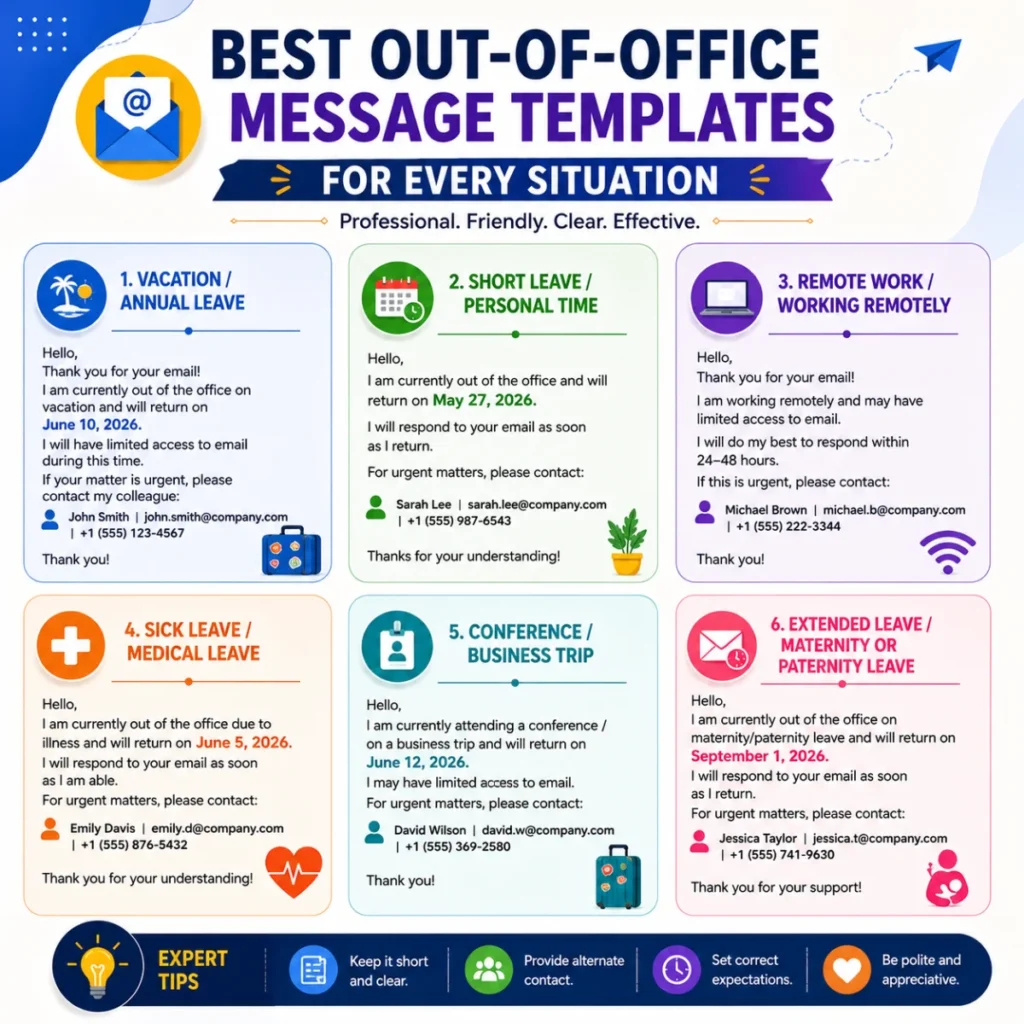
Vacation Leave
Keep it professional while protecting your privacy. Experts advise against oversharing personal details about your holiday plans, as it can seem boastful or even smug to someone who’s hard at work .
Template:
Subject: Out of Office: [Your Name]
Hello,
Thank you for your email. I’m currently out of the office on vacation and will return on [Date].
If you need immediate assistance, please contact [Name], [Title], at [Email] or [Phone]. I will respond to other inquiries when I return.
Best regards, [Your Name]
Short-Term Absence
For brief absences like a day off, training, or a conference, be clear about your limited availability.
Template:
Thank you for your email. I will be out of the office today from [Time] until [Time] and will not have access to email.
For urgent matters, kindly contact [Name] at [Phone] or [Email]. I can address all other matters once I return.
Best, [Your Name]
Conference or Business Travel
Use your OOO as an opportunity to network or share insights, but keep the professional tone.
Template:
Thanks for reaching out! I’m currently at [Conference Name] from [Date] to [Date] with limited email access.
If you need immediate assistance, please contact [Name] at [Email]. Otherwise, I’ll be back in the office on [Date] and will respond to your message then.
Looking forward to sharing insights from the conference!
Best, [Your Name]
Sick Leave
When you’re out sick unexpectedly, keep it brief and don’t overshare personal details. Include an estimated return date if possible .
Template:
Subject: Out Sick
Hello,
Thanks for your message. Unfortunately, I’m currently out sick and am unable to respond to emails. I hope to return to the office on [Date].
If you need a response in a timely manner, please contact [Name] at [Email] while I’m away.
Best, [Your Name]
Extended Leave (Parental Leave, Sabbatical)
For longer absences, provide more detailed contact information and assure continuity.
Template:
Hello,
I’m on parental leave through [Date] and won’t be monitoring email.
For project continuity, [Name] is the expert contact: [Email]. For administrative items, please contact [Name] at [Email].
I appreciate your support during this special time and look forward to reconnecting when I return.
Best, [Your Name]
Internal Message for Colleagues
Internal OOO messages can be more casual but should prevent work blockers by directing team members to relevant resources .
Template:
Hi team,
I will be on leave from [Date] to [Date]. [Name] will be handling my existing projects while I’m gone.
For urgent issues, check our [Slack channel / project folder]. Otherwise, we can touch base when I return.
Thanks, [Your Name]
Holidays and Company Shutdown
When your company closes for a holiday period, adjust your message to reflect the longer closure.
Template:
Hello,
In compliance with our company policy, we are closed for the holiday period from [Date] to [Date]. I will not have access to emails during this time.
I will respond to your messages immediately upon my return. For emergencies, you may call [Phone] or email [Emergency Email].
Happy Holidays! [Your Name]
Checking Emails Periodically
If you need to stay somewhat connected, be transparent about your limited availability .
Template:
Hello,
I am currently out of the office but will be checking email periodically. I will respond within 24-48 hours of your message.
For urgent matters requiring immediate attention, please contact [Name] at [Email].
Thank you for your understanding, [Your Name]
Should You Use Humor in Your Out-of-Office Message?
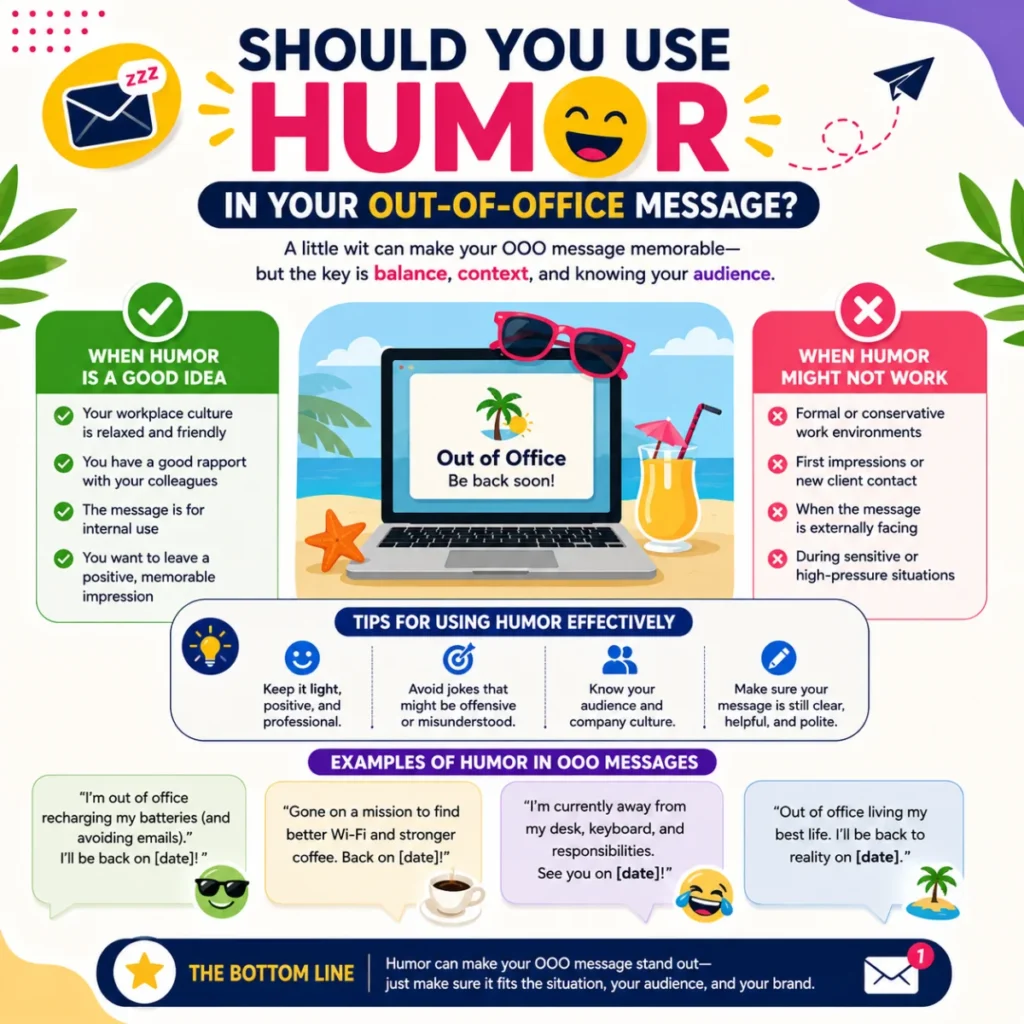
Humor can make your OOO stand out, but experts warn that it can backfire if not done carefully. Overly glib or sarcastic messages can anger clients or colleagues—one sales executive reportedly lost a deal after a joke in an OOO upset a client .
If you’re considering a funny OOO, ask yourself: would you put the same thing in a regular email? . Ensure the humor aligns with your workplace culture and your audience. What works for a creative agency might not suit a financial institution .
Best Practices for Funny OOOs:
- Keep it simple and brief
- Know your audience and workplace culture
- Don’t sacrifice clarity for humor
- Always include essential details like return dates and backup contacts
Common Mistakes to Avoid
Expert guidance from etiquette consultants and career specialists highlights several pitfalls to avoid :
- Oversharing personal details: Avoid boasting about vacations, second homes, or expensive hobbies
- Virtue signalling: Comments about “quality time with family” can seem smug to someone working hard
- No return date or backup contact: A bare message raises more questions than it answers
- Vague availability claims: Saying you’ll have “limited access” invites people to keep contacting you
- Overpromising on return: Don’t promise instant replies; a backlog is normal, so “within a few days” is more realistic
- Forgetting to turn it off: A stale OOO looks disorganized
Tailoring Messages for Internal vs. External Audiences
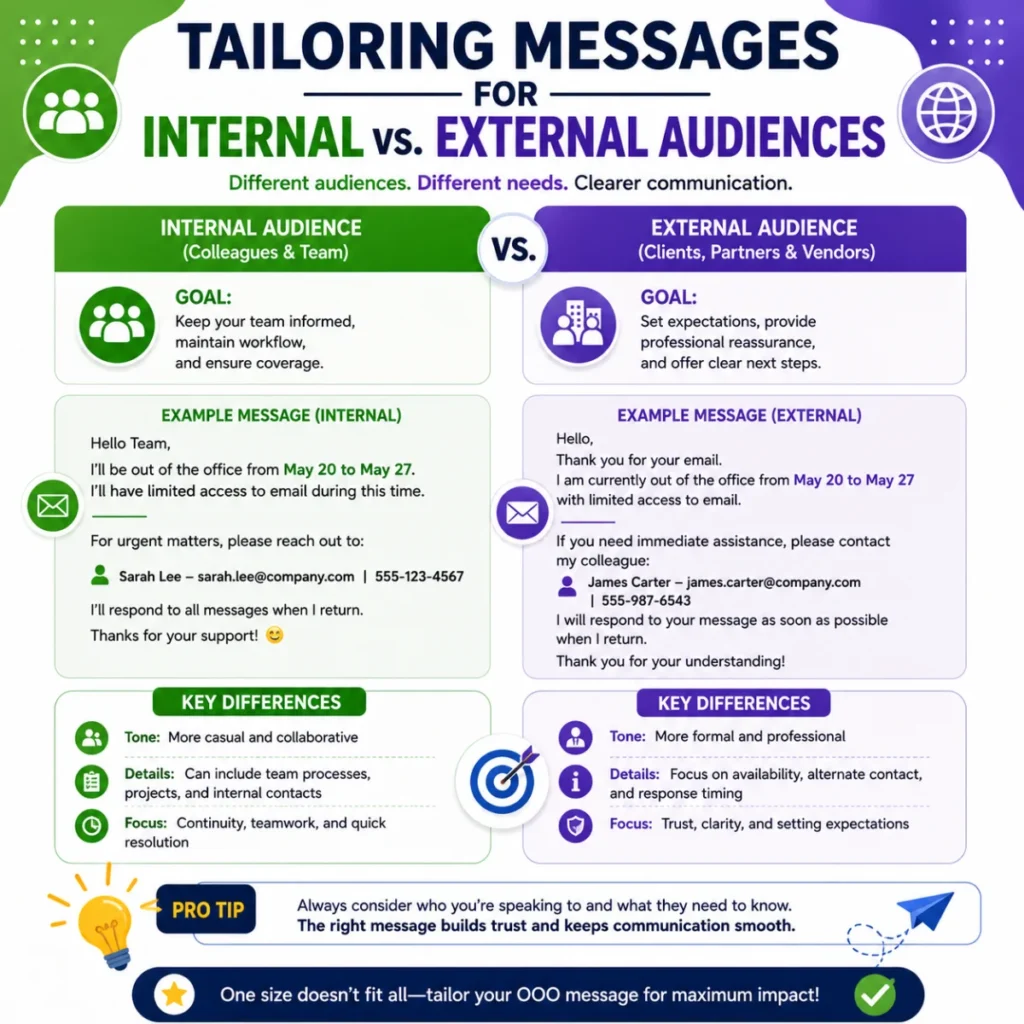
External and internal audiences have different expectations. Outlook’s Automatic Replies feature lets you tailor responses so clarity and continuity aren’t lost while you’re away .
For External Contacts (Clients, Vendors, Partners):
- Keep it concise, safe, and professional
- Avoid exposing internal information
- Provide a single point of contact if necessary
- Don’t list multiple colleagues if you receive spam or sales emails
For Internal Contacts (Colleagues):
- Include who is covering specific tasks and projects
- Provide directions to key files and resources
- Clarify escalation rules and what can wait
- Match the tone to the occasion (warm for annual leave, more formal for professional development)
FAQs
What should I include in a professional out-of-office message?
Include your dates away, whether you’ll be checking email, who to contact in your absence, and what will happen to incoming messages. Also include links to frequently requested info if relevant .
Is it okay to use humor in an out-of-office message?
Humor can work if it matches your workplace culture and audience. But beware that jokes don’t always land well over email and can even cost you business opportunities .
What’s the most important thing to include?
A specific return date and a backup contact are essential. Without these, people don’t know when to expect a reply or who else can help, leading to unnecessary follow-ups .
Should I say “limited access to email”?
Experts suggest this phrase can invite people to keep contacting you. If you need a real break, say so clearly: “I won’t be checking emails during this time” . In the UK and many countries, you have a legal right to uninterrupted annual leave unless your contract says otherwise .
How do I set separate internal and external messages?
Use Outlook’s Automatic Replies feature to tailor responses for internal and external audiences. This allows you to provide different levels of detail depending on who’s emailing you .
Conclusion
Writing the best out-of-office message is about balancing professionalism with clarity. A well-crafted OOO reassures the reader with clarity and warmth, making it clear help is available even while you’re away . It’s your last chance to make a good impression before you disconnect—and to manage expectations so you can actually enjoy your break.
Whether you’re heading on vacation, attending a conference, or taking a personal day, these templates and tips will help you create an out-of-office message that protects your time, maintains professional relationships, and ensures a smoother return to work. Remember: the best OOO is the one that communicates exactly what people need to know—no more, no less.

Hamid Mehmood is a passionate content creator dedicated to making words, messages, and online expressions easy to understand. He enjoys creating clear, helpful content that helps readers discover meanings and communicate with confidence.