You’ve just learned that someone you know has experienced a loss, and you want to reach out. But finding the right words can feel impossible. The good news is that a short condolence message is often exactly what’s needed. A brief, sincere message can mean more than a lengthy letter, especially when the person is overwhelmed with grief .
A short condolence message does not need to be elaborate. A card with one true sentence in it lands better than a card with a paragraph of arranged phrases . The key is sincerity, not length. This guide provides everything you need to write a short, meaningful condolence message for any situation.
What Makes a Short Condolence Message Effective?
A short condolence message works when it follows a few simple principles. A message that works is usually short, specific, and asks nothing of the person reading it . For example: “Just heard about your dad. I am so sorry. No need to reply.” This is a complete message that arrives in the first hours and is worth more than a longer one composed over three days .
The three rules of an effective condolence message are straightforward :
- Don’t ask a question. “How are you doing?” obliges an answer from the one person least able to give one. Instead, say “no need to reply” and mean it.
- Name the person. “Your dad” is warmer than “your loss.” If you knew them, one specific detail is worth a paragraph.
- Offer a specific thing or offer nothing. “Let me know if you need anything” moves the work onto them. “I am dropping food off Tuesday” does not.
Short Condolence Messages You Can Send As They Are
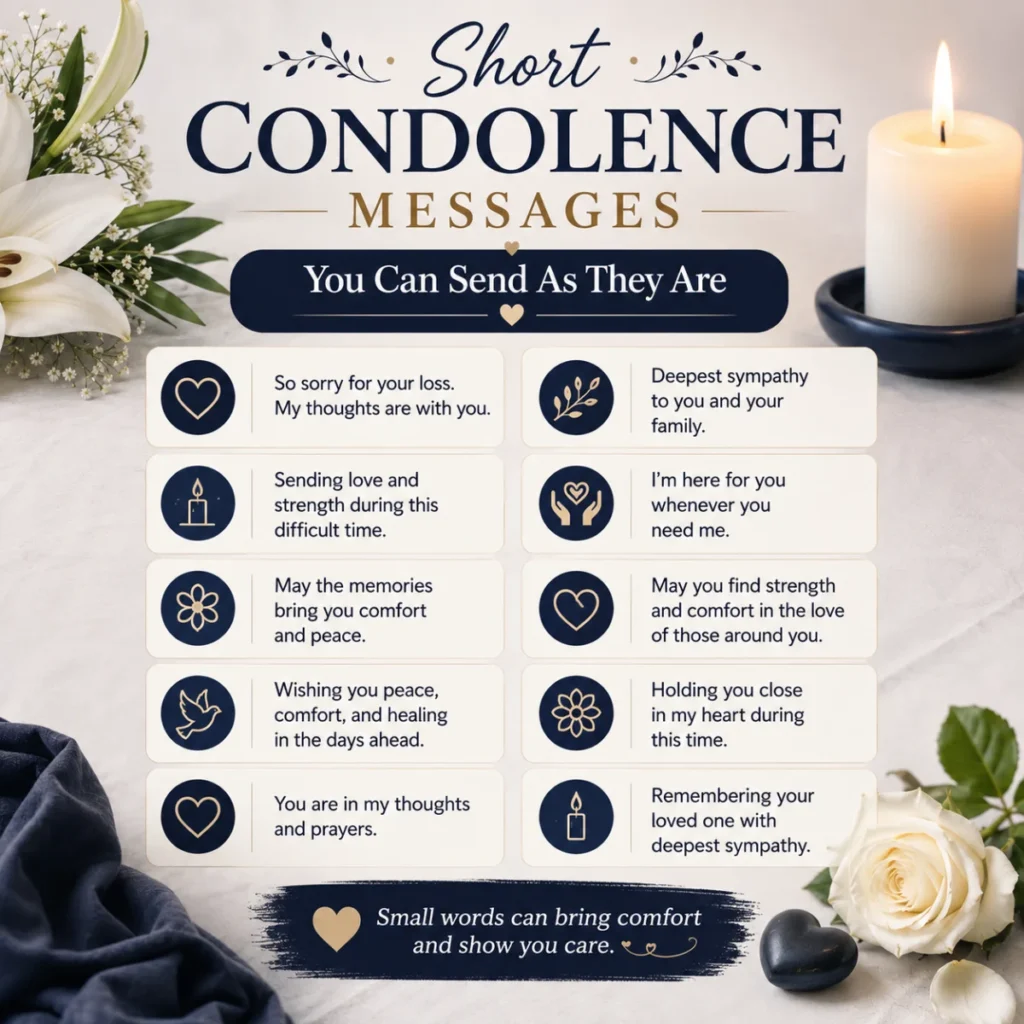
Here are short condolence messages you can use as written :
- I am so sorry for your loss.
- Thinking of you.
- There are no words. So sorry.
- Sending love to you all.
- With deepest sympathy.
- Holding you in my thoughts.
- No words, just love.
- Here for you, always.
- With sympathy and love.
- I am so sorry about your mom.
- Thinking of you and your family today.
- I am so sorry about your dad. No need to reply to this.
- I heard. I will check in Sunday.
- So sorry to hear about your loss. I am here if you need anything.
The Shortest Ones — Five Words or Fewer
For a flower card, a group card signature, or a quick text :
- I am so sorry.
- Thinking of you.
- With deepest sympathy.
- So sorry for your loss.
- With love and sympathy.
- Sending love to you all.
- No words. So sorry.
- Here for you, always.
- With sympathy and love.
- Holding you in my thoughts.
These messages are short enough to fit anywhere, and none requires the reader to do anything .
Short Condolence Messages by Relationship
For a Close Friend
When writing to a friend, you can be more personal. Use their loved one’s name and share a memory if you have one :
- “I loved your mom. I loved how she answered the phone.”
- “I keep expecting to see her. I cannot imagine what this week is for you.”
- “I loved him too. Thinking of you all.”
- “I am here for you always. If you want to talk or just need someone to listen, just say the word.”
- “I am bringing food over on Thursday. You don’t need to talk to me.”
For a Colleague or Professional Contact
In the workplace, offering condolences should balance compassion with professionalism :
- “I was so sorry to hear about your father. Please take whatever time you need — everything here is covered.”
- “So sorry for your loss. Thinking of you and your family.”
- “Our thoughts are with you at this time. Sincere condolences from the whole team.”
- “Please accept my deepest sympathies for your loss.”
- “Thinking of you. Everything is steady here.”
For an Acquaintance or Someone You Don’t Know Well
The instinct to say nothing because you are not close enough is understandable, but sending something is still meaningful :
- “So sorry to hear your news.”
- “I do not know you well but I wanted to say I am sorry.”
- “Sorry for your loss. Nothing needed from you here.”
- “Very sorry. Take whatever time you need.”
- “I never met your dad, but I’ve heard enough about him to know what you’ve lost.”
Short Condolence Messages for Specific Losses
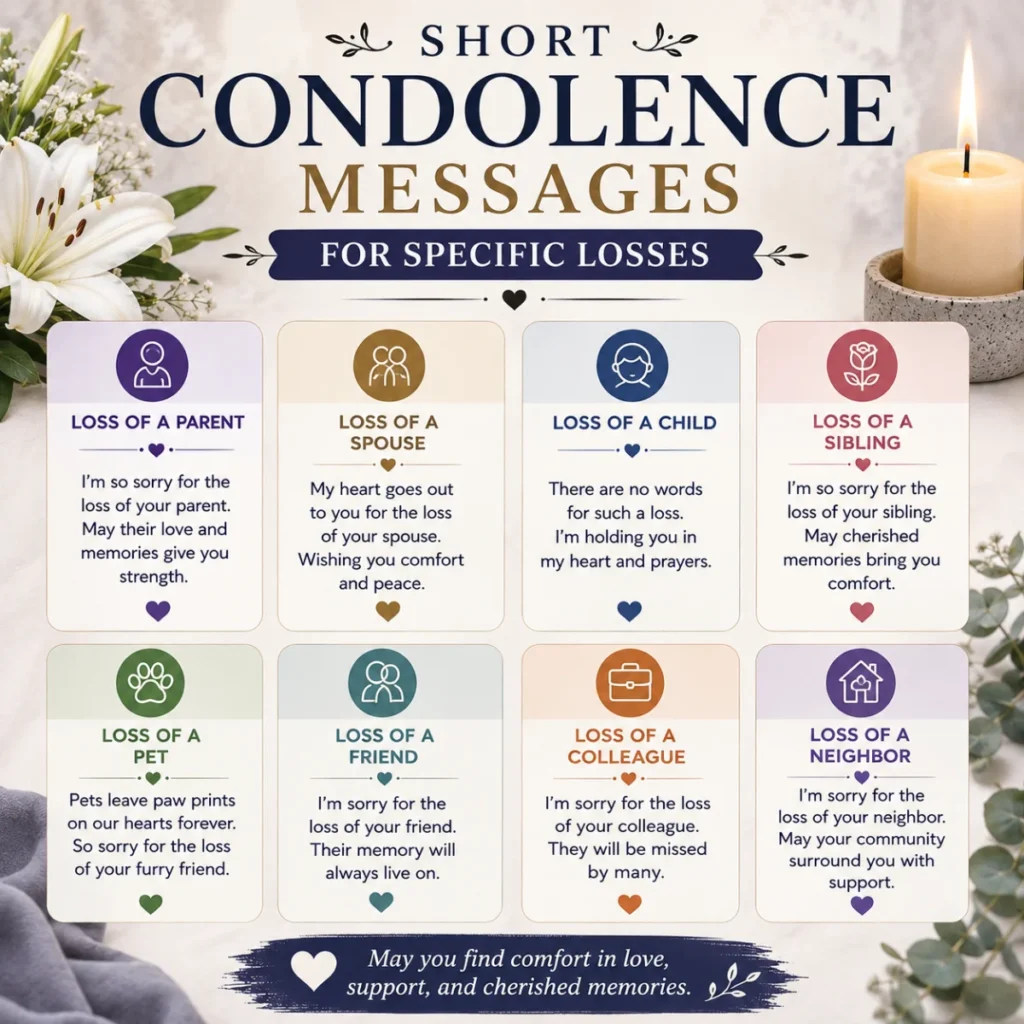
Loss of a Mother
- “I am so sorry about your mom.”
- “Your mother was a lovely woman and I will miss her.”
- “She was so proud of you. She told me often.”
- “Thinking of you and your family today.”
- “I am so sorry. I loved her too.”
Loss of a Father
- “I’m so sorry about your dad.”
- “So sorry to hear about your father. No need to reply to this.”
- “I heard about your dad. I’m so sorry. I’m here whenever.”
- “Sending you love. Your father was a good man.”
- “I’m sorry. He was one of the good ones.”
Loss of a Spouse or Partner
- “I’m so sorry about Michael. Thinking of you.”
- “I’m so sorry about your husband.”
- “I’m so sorry about your wife.”
- “I’m coming over on Thursday with food. You don’t need to talk to me.”
- “I’ll still be checking in when everyone else has stopped.”
Loss of a Child
Writing about the loss of a child requires extra sensitivity. Keep your message simple and sincere :
- “We were so sad to learn about [Name]. My heart is with your family.”
- “I am so sorry for your loss. [Name] will always be remembered.”
- “I keep thinking about [Name]. What a special person.”
- “There are no words. I am just so sorry.”
- “Thinking of you and your family during this difficult time.”
Loss of a Pet
- “Losing a pet is always difficult. I know they were loved and you gave them a great life.”
- “I was so sorry to hear about [Pet’s name]. They meant so much to you.”
- “Sending you comfort and love as you remember your dear friend.”
- “Our condolences on the loss of [Pet’s name]. We know they meant a great deal to you.”
- “Thinking of you and your family. They were lucky to have you.”
Short Condolence Messages for Different Channels
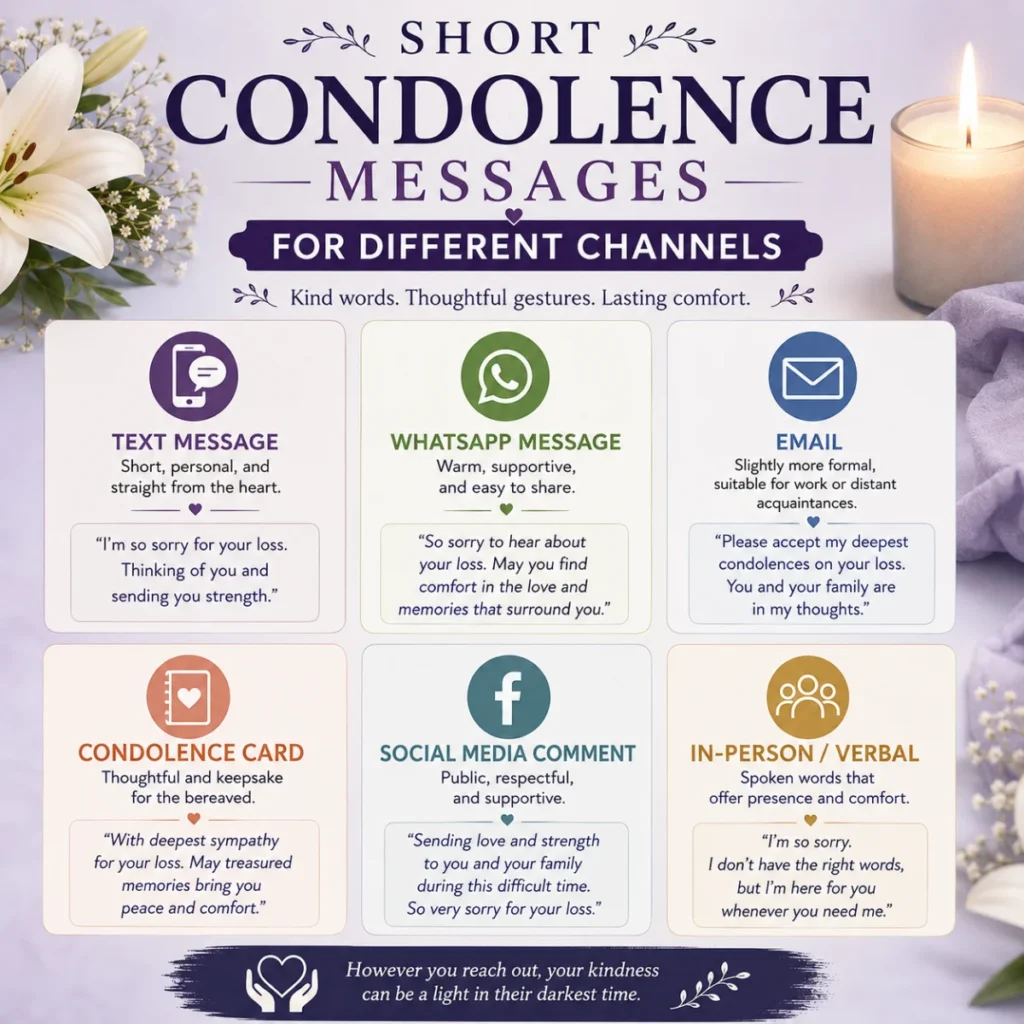
For a Text Message
Text is now the most common way to send condolences, and it has stopped being the lesser option. A card still matters, but the text arrives when the person is sitting with nothing to do, and that timing is most of its value .
- “I just heard about your mom. I am so sorry. No need to reply.”
- “Thinking of you today. No need to reply.”
- “So sorry to hear about your dad. Here whenever you want company.”
- “No words, just love.”
- “I heard. I will check in Sunday.”
For a Sympathy Card
A card is slower, warmer, and kept. It is the only one of these that still exists in a drawer twenty years later . Send one as well as a text — the text is for now and the card is for later.
- “I am so sorry about your father. He was a genuinely kind man.”
- “She was so proud of you. I hope you know that.”
- “With deepest sympathy for the loss of your mother.”
- “I wish I had the right words. I do not, but I am here.”
- “Sending you every kind thought I have.”
For a Flower Card or Wreath Ribbon
- “In loving memory of a wonderful man.”
- “Forever in our hearts.”
- “With love from all of us.”
- “Thinking of you — [Your Name].”
- “Always remembered.”
For a Group Card at Work
When signing a group card, keep it warm and brief :
- “So sorry for your loss — [Your Name]”
- “Take all the time you need. — [Your Name]”
- “Very sorry to hear your news. — The whole team”
- “Sorry. Here if you need anything at all. — [Your Name]”
What to Avoid in a Short Condolence Message
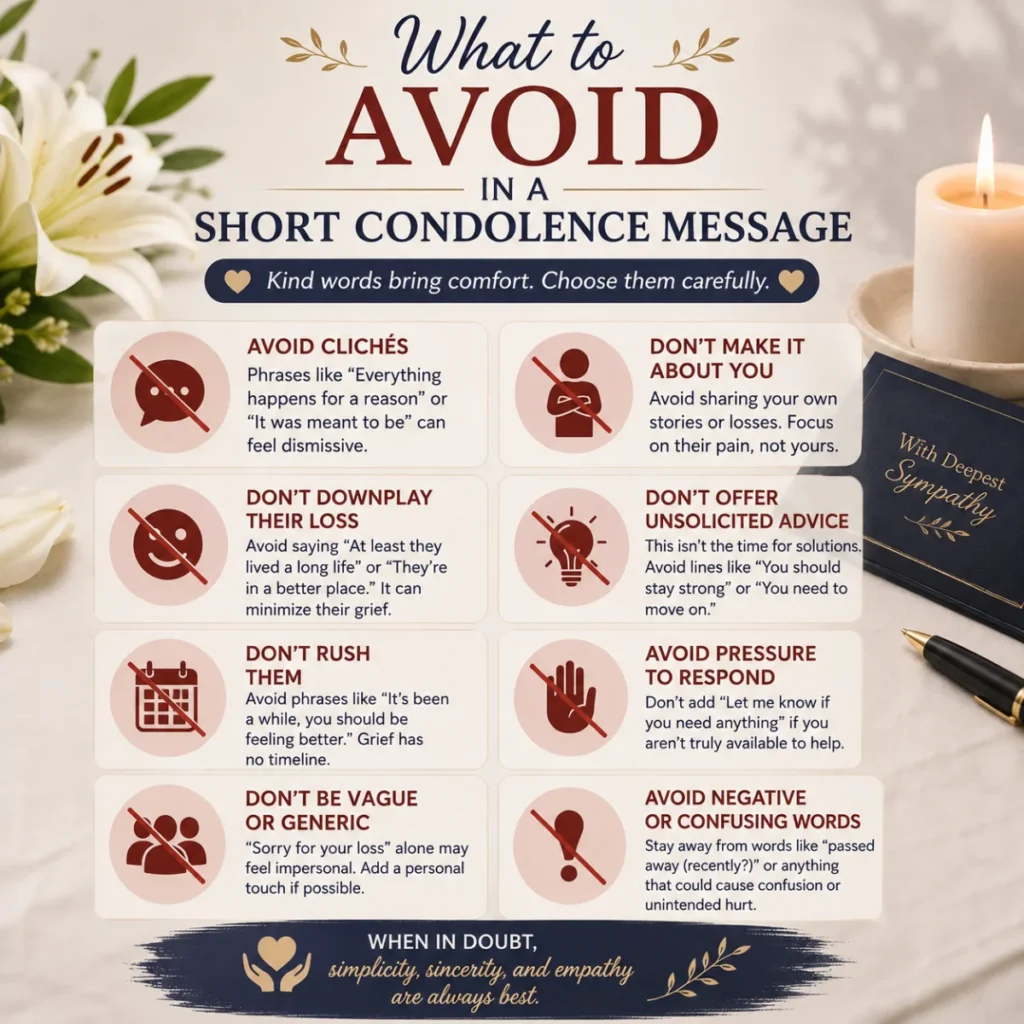
Even with good intentions, certain phrases can be hurtful :
Avoid minimizing the loss:
- “At least she lived a long life”
- “At least he didn’t suffer”
- “You were lucky to have had that”
- “He’s in a better place”
Avoid clichés:
- “Everything happens for a reason”
- “They’re not suffering anymore”
- “I know exactly how you feel”
Avoid making it about you:
- Don’t share your own grief extensively
- Don’t offer advice on how to grieve
- Don’t say “You need to be strong”
Avoid asking questions:
- “How are you doing?” puts pressure on the grieving person
- Don’t ask for details about the death
When to Send a Short Condolence Message
Send your message as soon as you learn about their loss . The single most useful thing you can do is send condolences the day you hear — it beats a better message next week, every time .
The first week brings a flood of messages, and the fifth week brings silence. Your imperfect text arriving on day one joins the flood, which is fine — that is what the flood is for .
Follow-Up Timing
Don’t stop after the first message. Consider sending a follow-up :
- Two to eight weeks later: “Still thinking of you. No reply needed.”
- The first anniversary: “Thinking of you today. I know what day it is.”
- The first birthday or holiday: “Thinking of you and your family today.”
FAQs
What is a short condolence message?
A short condolence message is a brief expression of sympathy for someone who has experienced a loss. It acknowledges their grief and offers comfort without being lengthy or overwhelming.
Can I send a condolence message by text?
Yes, sending condolences by text is now common and often the most effective way to reach someone immediately . Keep it short, sincere, and don’t ask questions.
What should I say if I don’t know what to write?
Keep it simple: “I am so sorry for your loss. Thinking of you.” Sincerity matters more than eloquence .
What should I avoid saying?
Avoid clichés like “Everything happens for a reason” or “They’re in a better place.” Also avoid offering advice or asking questions about the death .
Is it okay to send a short message if I didn’t know the deceased?
Yes. A short message like “I’m so sorry for your loss” is still meaningful . You don’t need to have known the person to show support to someone who is grieving.
What if I’m not close to the person?
A brief, sincere message is still appropriate. Something like “Thinking of you during this difficult time” works well for acquaintances or colleagues .
Conclusion
A short condolence message is often the best kind of message you can send. It arrives quickly, it asks nothing of the grieving person, and it communicates that you care. You don’t need the perfect words — you just need to reach out.
The most common mistake people make is waiting too long because they want to find the right words. A simple message sent today is worth more than a perfect message sent next week. Send it now, keep it brief, and let the person know they are in your thoughts.

Hamid Mehmood is a passionate content creator dedicated to making words, messages, and online expressions easy to understand. He enjoys creating clear, helpful content that helps readers discover meanings and communicate with confidence.