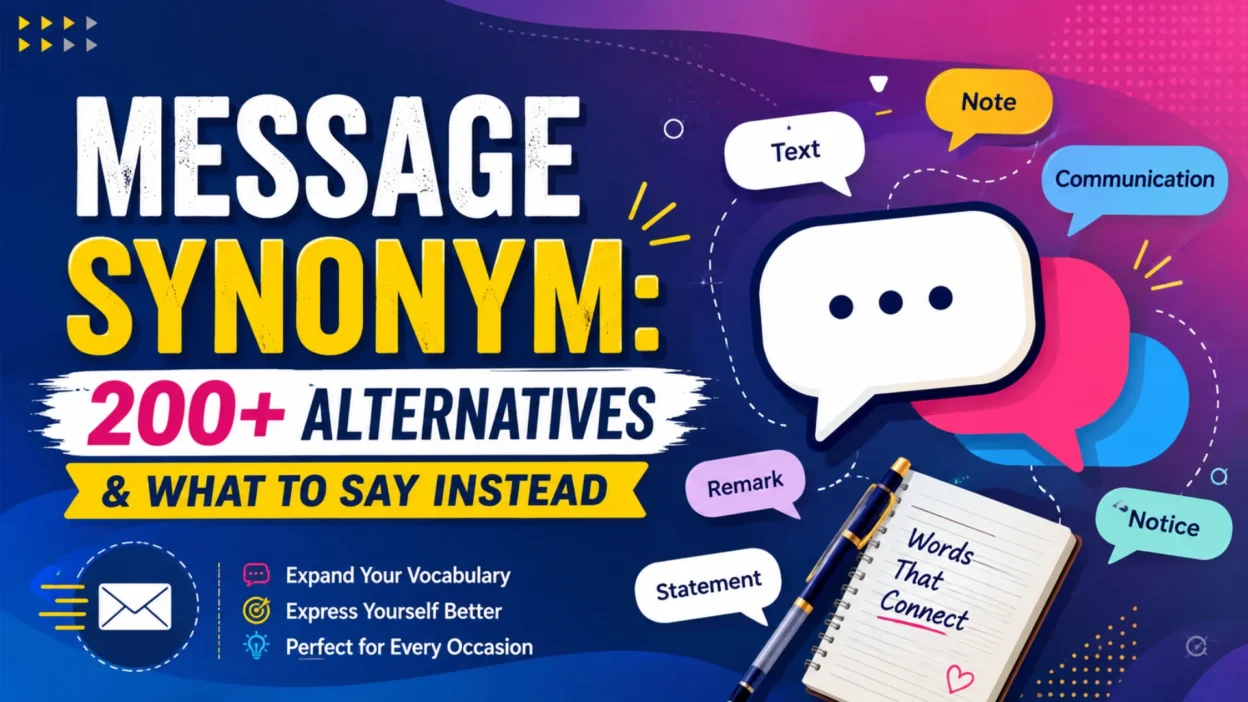
The word “message” is one of the most frequently used terms in modern communication. From texts and emails to memos and letters, we send and receive messages constantly. But using the same word repeatedly can make your writing feel repetitive and uninspired. Fortunately, the English language offers a wealth of alternatives.
Whether you’re writing a professional email, crafting a creative piece, or simply want to avoid repetition, knowing the right synonym for “message” can elevate your communication. This guide explores over 200 synonyms categorized by context, formality, and specific situations, helping you choose the perfect word every time.
What Does “Message” Actually Mean?
Before exploring alternatives, it helps to understand the full meaning of “message.” The term can refer to several distinct concepts.
A piece of communication — A verbal, written, or recorded communication sent to or left for a recipient who cannot be contacted directly. This includes texts, emails, notes, memos, and phone messages.
An underlying meaning or moral — The central theme, main point, or significance conveyed by a work of art, film, speech, or essay. For example, “The movie’s message was about the importance of family.”
An errand or task (British usage) — In British English, “running messages” means running errands or doing tasks.
This rich set of meanings means that choosing the right synonym depends on understanding which sense of “message” you’re using.
Most Popular Message Synonym
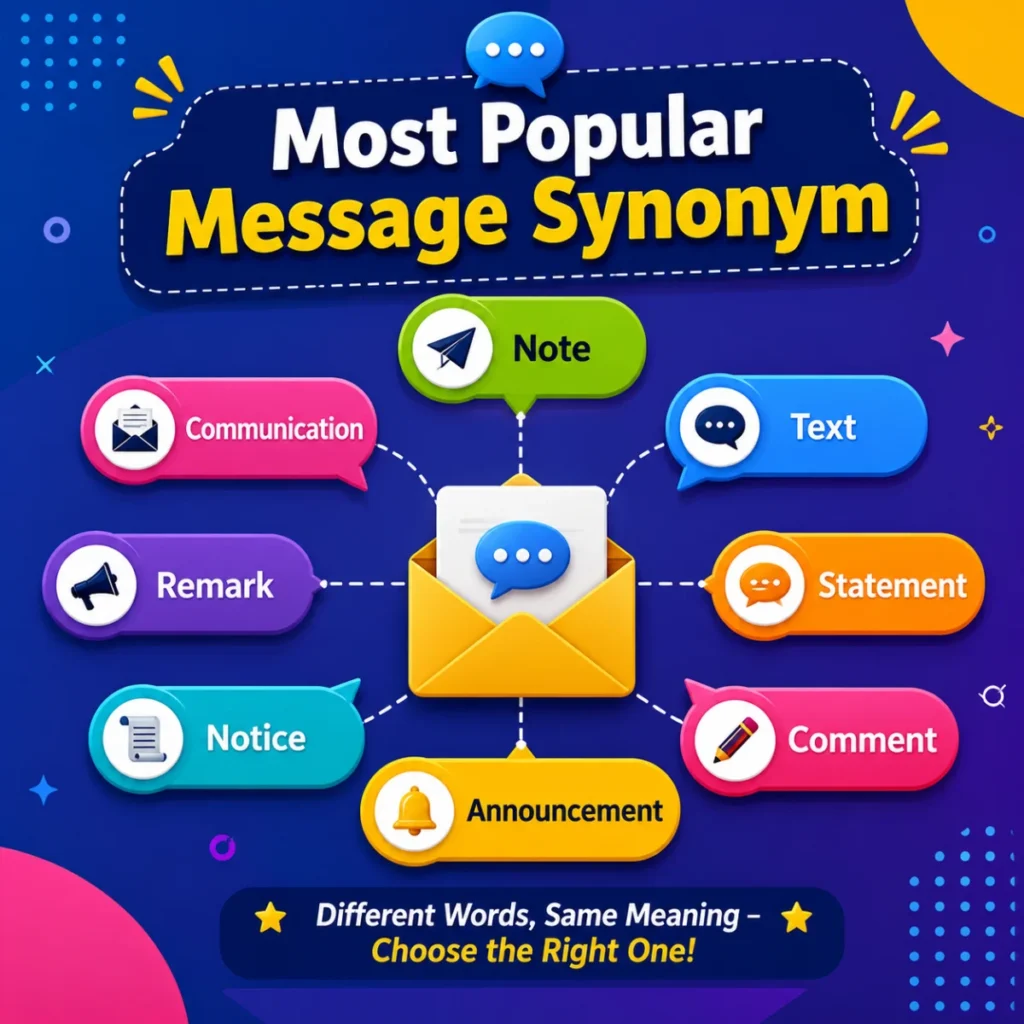
According to comprehensive thesaurus data, the most widely used alternatives for “message” include communication, information, intelligence, news, and word for general communication. For written notes, alternatives include note, memo, memorandum, letter, missive, and dispatch. Official statements can be called bulletins, announcements, communiqués, notices, or notifications. When referring to underlying meaning, you can use meaning, point, gist, import, purport, theme, moral, or significance. For digital communication, common terms include text, email, DM, tweet, posting, and chat.
Synonyms by Context and Purpose
For Business and Professional Communication
When writing in professional settings, choose synonyms that convey clarity and appropriate formality.
Memo or Memorandum — A short written note sent to one person or a group within an organization, providing information, instructions, or announcements. For example, “The manager sent a memo announcing the new office hours.”
Communication — The exchange of information and ideas between people through speaking, writing, or signals. This is the broadest alternative and works well for formal contexts.
Dispatch — An urgent official message, often from a correspondent or military source. For example, “The ambassador sent a dispatch to the foreign office.”
Communiqué — An official announcement or statement, often political or diplomatic.
Notice — Formal warning or notification of something. For example, “Unions are required to give seven days’ notice of industrial action.”
Bulletin — A short official statement or broadcast summary of news.
For Written Messages
When referring to a written piece of communication:
Note — A brief piece of writing about something, like a reminder or comment. For example, “I left a note on the table.”
Missive — A formal or old-fashioned term for a letter or written message. For example, “the customary missive from your mother.”
Letter — A written or printed communication addressed to someone.
Text — A short message sent on a phone or the words written or printed on paper or a screen.
For Digital and Modern Communication
Today’s communication landscape has created many new synonyms.
Text Message — A short electronic message sent via mobile phone.
DM (Direct Message) — A private message sent on social media platforms like Twitter/X or Instagram.
Email (or E-mail) — Electronic mail sent via the internet.
IM (Instant Message) — A real-time text message sent through a chat application.
Mention — A message that directly addresses someone by their username on social media.
Notification — An alert or message that appears on a device to inform the user of something.
For Underlying Meaning and Moral
When you’re referring to the message behind a work of art, speech, or story:
Theme — The central subject or idea being explored. For example, “The novel’s central theme is obsession.”
Moral — The lesson or ethical principle conveyed. For example, “The moral of the story is, let the buyer beware.”
Point — The main idea or purpose. For example, “You have missed the main point of my argument.”
Meaning — The significance or interpretation of something.
Gist — The essential or main part of a message.
Import — The significance or meaning of something. For example, “I have already spoken about the import of his speech.”
Purport — The intended or apparent meaning. For example, “The purport of his speech was obvious.”
Substance — The essential or real meaning.
Thrust — The main point or central meaning.
For British English: Errand or Task
In British English, “message” can mean an errand or task.
Errand — A short journey to perform a task. For example, “I spent the morning running errands.”
Task — A piece of work to be done. For example, “He had the unenviable task of breaking the bad news.”
Mission — A task or assignment. For example, “the most crucial stage of his latest peace mission.”
Commission — A task or piece of work given to someone. For example, “She approached me with a commission to write the screenplay for the film.”
Chore — A routine task or errand.
For Signs and Indications
Sometimes a “message” isn’t spoken or written but implied through action or circumstance.
Signal — An indication or sign of a situation.
Indication — A sign that suggests something.
Sign — An object, quality, or event indicating something.
Portent — A sign or warning that something significant is about to happen.
Omen — An event regarded as a portent of good or evil.
Synonyms as Verbs (Sending Messages)
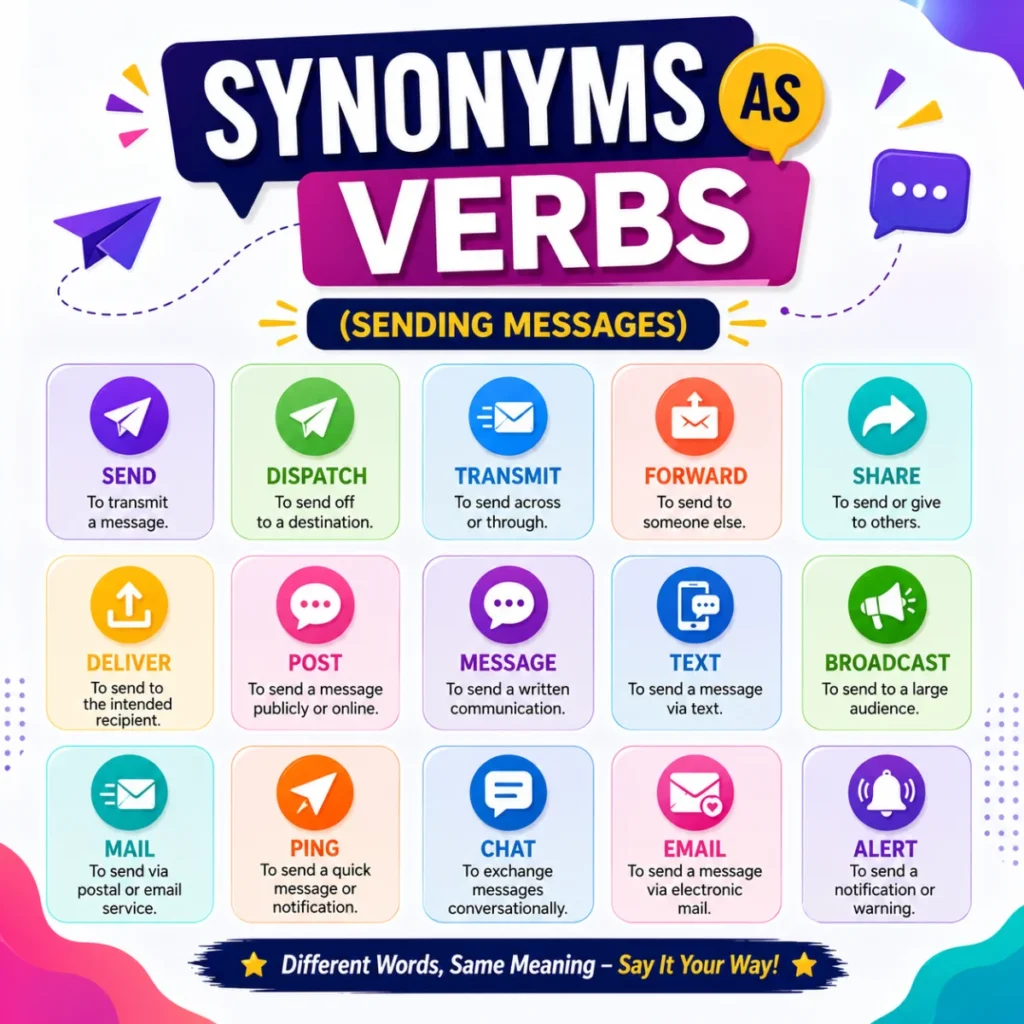
“Message” is also used as a verb meaning to send someone a message.
Communicate — To exchange thoughts or make known information by speech, writing, or other means. For example, “My natural mother has never communicated with me.”
Text — To send a text message.
DM — To send a direct message on social media.
IM — To send an instant message.
Email — To send an email.
Write — To communicate by writing letters or mail.
Notify — To inform someone of something.
How to Choose the Right Message Synonym
Selecting the perfect alternative to “message” depends on several factors.
Consider the Context
In formal writing, use communication, memorandum, communiqué, or dispatch. For informal writing, use note, text, DM, or word. In professional settings, use memo, bulletin, notice, or notification. In creative writing, use missive, theme, moral, or purport.
Consider the Medium
For email, use email, message, or communication. For text or SMS, use text, text message, or SMS, social media. To use DM, mention, post, or tweet. For a letter, use letter, note, or missive.
Consider What You’re Communicating
For general information, use communication, word, or information. For brief information, use note, memo, or text, official information, use bulletin, dispatch, communiqué, or notice. To underlying meaning, use theme, moral, point, meaning, or gist.
The British Usage of “Message”
One interesting nuance is the British usage of “message” to mean an errand or task. In British English, “running messages” means “running errands.” This usage differs from the common American understanding of “message” as a communication. If you’re writing for a British audience, be aware that “message” in this sense is synonymous with errand, task, job, mission, commission, or chore.
Quick Reference List of Synonyms
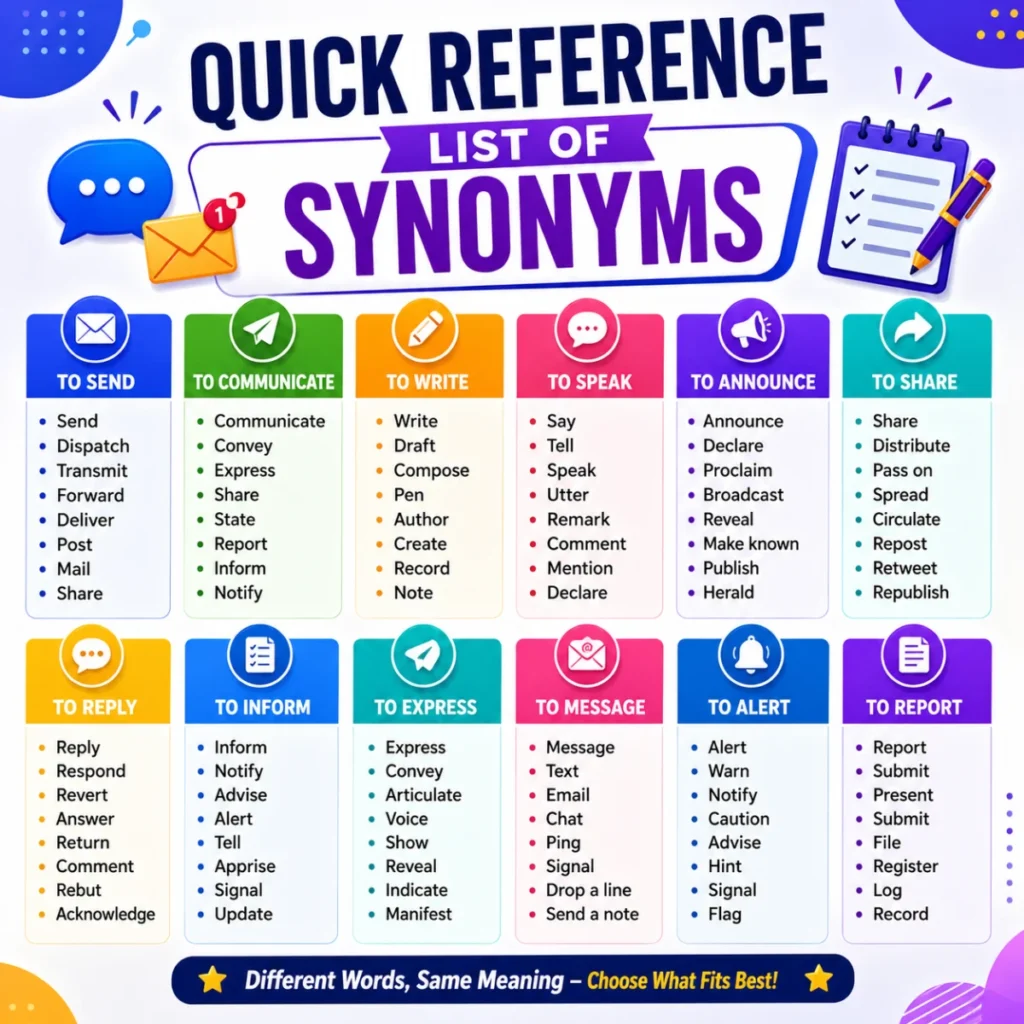
Communication (General)
Announcement, bulletin, communiqué, communication, dispatch, information, intelligence, news, notice, notification, statement, transmission, word.
Written Communication
Card, letter, memo, memorandum, missive, note, post, posting, text.
Digital Communication
DM, email, IM, SMS, text message, tweet, chat, mention, notification, ping.
Underlying Meaning
Gist, idea, import, implication, meaning, moral, point, purport, significance, substance, theme, thrust, essence.
Signs and Indications
Indication, omen, portent, sign, signal.
British English (Errand/Task)
Chore, commission, errand, job, mission, task.
Professional/Official
Communiqué, directive, instruction, memo, notification, notice, order.
FAQs
What is the most common synonym for message?
The most popular synonyms for “message” include communication, note, text, memo, missive, and dispatch. The best choice depends on your context.
What can I say instead of “message” in a professional email?
Use memo, memorandum, bulletin, communication, or notification for professional settings. For example, “Please review the memo I sent yesterday” sounds more professional than “Please review the message I sent.”
Is “message” formal or informal?
“Message” is generally used in neutral contexts. It works in both formal and informal situations, making it a versatile choice.
What is a synonym for “message” in literature or art?
When discussing the meaning behind a creative work, use theme, moral, meaning, purport, import, or significance. For example, “The film’s theme is redemption” is more precise than “The film’s message is redemption.”
What is the British synonym for “message”?
In British English, “message” can mean an errand or task. Synonyms in this context include errand, task, job, commission, and mission.
What is an old-fashioned word for message?
Missive is a more formal or old-fashioned term for a written message or letter. It works well in creative or historical writing.
Conclusion
The English language offers hundreds of alternatives to the word “message,” each with its own nuance and appropriate context. Whether you’re writing a professional memo, a creative piece, or a simple text, choosing the right synonym can make your communication more precise and engaging.
Remember that context matters: a “memo” belongs in an office, a “missive” feels formal and old-fashioned, a “DM” is for social media, and a “moral” belongs in a story. By understanding these distinctions, you can select the perfect word for every situation. And if you’re writing for a British audience, don’t forget that “message” might also mean an “errand” — one of those delightful quirks of the English language.

Hamid Mehmood is a passionate content creator dedicated to making words, messages, and online expressions easy to understand. He enjoys creating clear, helpful content that helps readers discover meanings and communicate with confidence.