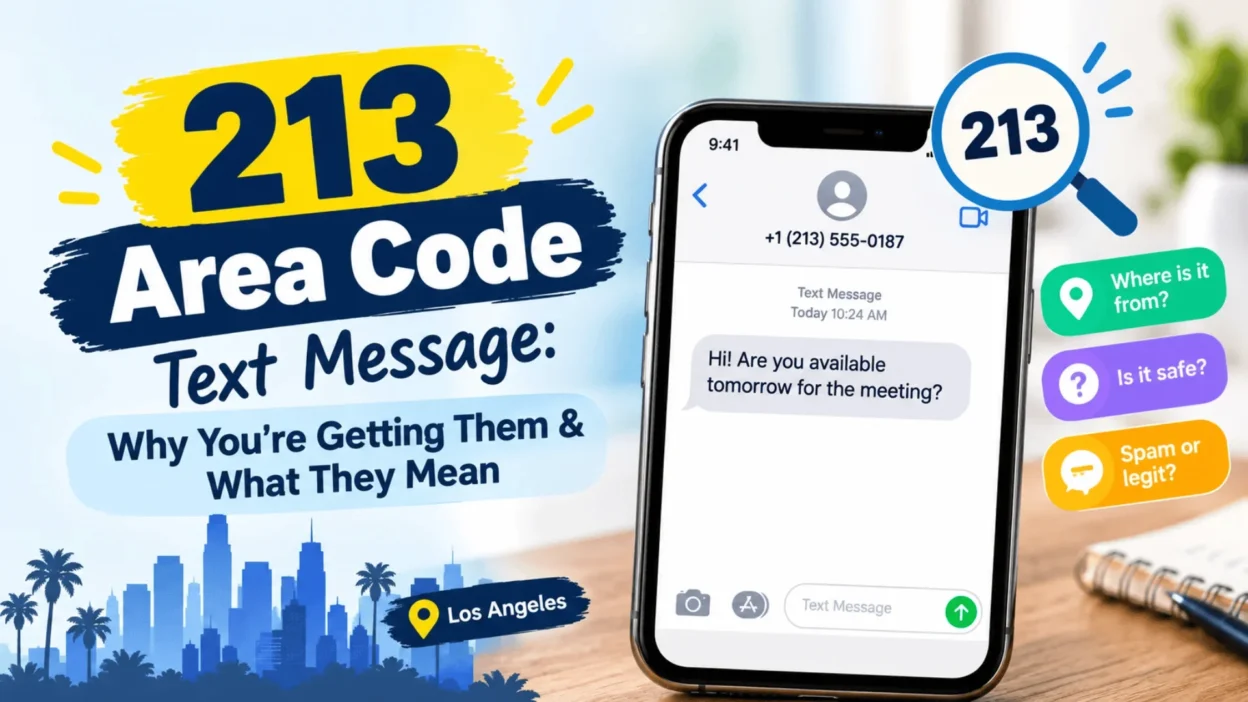
If you’ve recently received a text message from an unknown number with a 213 area code, you’re not alone. Thousands of people across the United States have reported getting similar messages, and the vast majority of them are scams . The 213 area code is one of the most frequently spoofed area codes in the country, making it a common front for fraudsters looking to trick people into handing over personal information or money.
This guide explains what the 213 area code actually is, why it’s associated with so many scam texts, the common tactics scammers use, and exactly what you should do if you receive one of these messages.
What Is the 213 Area Code?
The 213 area code is a legitimate telephone area code located in California, specifically serving the central and downtown Los Angeles area . It was one of the original area codes established in the United States back in 1947, and it originally covered the entire state of California before being subdivided as the population grew . Today, it covers neighborhoods like Downtown LA, Koreatown, East Los Angeles, Boyle Heights, Chinatown, Little Tokyo, and parts of Hollywood .
The area code has an overlay code, 323, which serves the same geographic region. This means a phone number in central Los Angeles could carry either the 213 or 323 prefix .
So the 213 area code itself is perfectly legitimate. The problem is that scammers use a technique called “spoofing” to make their calls and texts appear as though they’re coming from a 213 number, even when they’re actually operating from overseas .
Why You’re Getting Texts from the 213 Area Code
The short answer is that you’re almost certainly being targeted by a scammer. The 213 area code has become one of the top-reported area codes for scam calls and texts in the United States . Scammers choose it because Los Angeles is a major metropolitan area, which makes the number seem more credible to someone who might not recognize the area code.
Call spoofing allows fraudsters to falsify the number that appears on your caller ID. This means the text you receive might display a 213 number, but the person sending it could be anywhere in the world—often in India, Nigeria, or other countries known for operating these types of fraud operations . Because the number is fake, blocking it often doesn’t stop the messages, as the scammer will simply generate a new fake number and try again .
Common Types of 213 Area Code Text Scams
The 213 area code scam is a form of social engineering fraud. The goal is to win your trust and trick you into voluntarily disclosing personal or financial details . Here are the most common variations people have reported.
The “Wrong Number” or “Long Time No See” Scam
This is one of the most frequently reported 213 text scams. You receive a message that appears to be from someone you might know, such as “Hey, is this [your name]?” or “Hello, long time no see, how are you doing?” . The scammer is hoping you’ll reply to correct them or engage in conversation.
Once you respond, the conversation usually escalates. The scammer might claim they got a new phone and lost their contacts, or they might apologize for texting the wrong number but continue chatting to build rapport . Eventually, they’ll try to move the conversation to WhatsApp or another messaging app and introduce an “investment opportunity” or romance scam .
Fake Delivery or Order Notifications
Another common 213 text scam involves messages about a delivery or an order you didn’t place. You might get a text saying something like, “Your package is waiting to be picked up” or “Be ready for a pickup at 2:00 for our seafood lunch date” . These messages are designed to confuse you into clicking a link or replying to get more information. The links often lead to phishing sites designed to steal your login credentials or install malware on your phone.
Employment and Job Offer Scams
Some 213 area code texts target people looking for work. The message might ask, “Do you want to work remotely?” or offer a lucrative job opportunity . Once you express interest, the scammer will ask for a “processing fee,” “training fee,” or “equipment fee” upfront. This is a classic advance fee fraud. They take your money and disappear.
Financial and Loan Forgiveness Scams
Many people report receiving texts from 213 numbers claiming their student loan application has been approved, their debt relief is ready to finalize, or they qualify for a government grant . These messages typically contain links that direct you to fake websites designed to harvest your Social Security number, bank details, or other sensitive information.
Investment and Gold Scams
A specific variation involves someone pretending to be from a financial services company. People have reported texts claiming to be from “Michelle with AHG” (American Hartford Gold) saying they tried to call you and asking you to call back ASAP . These are attempts to get you on the phone to pressure you into buying gold or making other investments.
Political or Survey Scams
Some 213 texts try to engage you with a political question. One reported message asked, “Take the poll: Who should be the 2028 Democratic nominee for President?” with a link attached . These are designed to get you to click and potentially expose your data or confirm that your number is active.
The “Partners in Peace” Impersonation
A significant campaign involved texts from 213 numbers claiming to be from someone named David, Matthew, or Tom with an organization called “Partners in Peace” . The National Collegiate Honors Council, which actually runs a legitimate program by that name, has publicly warned that these texts are not from them and are impersonation scams .
Red Flags: How to Spot a 213 Area Code Scam
Several warning signs can help you identify a scam text before you engage with it.
You don’t know anyone in Los Angeles. If the 213 area code is unfamiliar to you and you have no connections to California, a text from that area is almost certainly fraudulent .
The message is vague and generic. Scam texts often start with “Hey,” “Hello,” or “Is this [your name]?” without any context . A legitimate message from someone you know would include specific information.
They ask you to move to WhatsApp or Telegram. This is a major red flag. Scammers want to move you off SMS because messaging apps are encrypted and harder for authorities to monitor .
There’s a link or a request to click. Legitimate texts from friends and family don’t usually contain suspicious links. Any link from an unknown number should be treated as dangerous .
They ask for personal information or money. No legitimate person or organization will ask for your Social Security number, bank details, or payment via text message.
The message creates a false sense of urgency. Phrases like “call me ASAP” or “your account will be suspended” are designed to panic you into acting without thinking .
What to Do If You Receive a 213 Area Code Text
If you get a text from a 213 number that you don’t recognize, follow these steps.
Do not respond. No matter how friendly or intriguing the message seems, do not reply. Responding confirms that your number is active and that a real person is reading the texts. This will likely result in more messages .
Do not click any links. Links in scam texts can install malware on your phone or direct you to phishing sites that steal your information .
Block the number. Use your phone’s blocking feature to stop further messages from that specific number. Keep in mind that scammers can easily switch to a new spoofed number .
Report the message as spam. Forward the text to 7726 (SPAM), the reporting number set up by phone carriers to combat spam texts . You can also report it to the FTC at ReportFraudFTC.gov .
Delete the message. Once reported and blocked, delete the text from your phone .
How to Protect Yourself from Future Scam Texts
Scammers will continue to target your number as long as it’s active, so taking proactive steps can reduce the volume of unwanted messages.
Never reply with “STOP.” While this works for legitimate marketing messages, scammers don’t honor opt-out requests. Replying “STOP” only confirms that your number is valid and monitored .
Be cautious about sharing your number. Only provide your phone number to trusted individuals and reputable businesses. Be wary of giving it out on social media or unsecured websites.
Use your phone’s built-in spam filtering. Both iPhone and Android devices have options to filter unknown senders. On iPhone, go to Settings > Messages > Unknown & Spam and enable “Filter Unknown Senders.” On Android, Google Messages has a spam protection feature you can enable in settings.
Don’t engage with “wrong number” texts. If someone claims to have the wrong number but continues chatting, block them immediately. This is a well-known social engineering tactic .
FAQs
Is the 213 area code always a scam?
No. The 213 area code is a legitimate area code for Los Angeles, California . However, it is one of the most frequently spoofed area codes in scam texts and calls . If you receive a text from a 213 number and you don’t know anyone in Los Angeles, it’s almost certainly a scam.
Why do I keep getting texts from different 213 numbers?
Scammers use number spoofing technology that allows them to generate multiple fake phone numbers. Blocking one number doesn’t stop the scammer because they simply switch to a new spoofed number and try again .
What happens if I reply to a 213 scam text?
Replying confirms to the scammer that your phone number is active and that you’re willing to engage. This usually results in more spam texts and could lead to more aggressive scam attempts, including phone calls and attempts to move the conversation to other apps .
Can I trace a 213 scam text to find the real sender?
No. Because the number is spoofed, it doesn’t reveal the actual location or identity of the scammer. The 213 number displayed is not the real origin of the message .
What should I do if I already clicked a link in a 213 scam text?
If you clicked a link, immediately run a security scan on your phone using a reputable antivirus app. Check your bank accounts and credit card statements for any unauthorized activity. If you entered login credentials, change those passwords immediately. If you provided financial information, contact your bank to alert them to potential fraud.
Is the “Partners in Peace” text from 213 a real organization?
No. The National Collegiate Honors Council, which operates the legitimate Partners in Peace program, has issued a warning that texts from individuals claiming to be from their organization are impersonation scams .
How do I report a 213 area code scam text?
Forward the text to 7726 (SPAM). You can also file a report with the FTC at ReportFraudFTC.gov. Reporting helps carriers and authorities identify and shut down scam operations .
Conclusion
Text messages from the 213 area code are almost always scams when they come from unknown senders. The 213 area code itself is legitimate, serving downtown Los Angeles, but scammers have adopted it as a favorite disguise because it makes their messages seem more credible to unsuspecting recipients .
The most important thing to remember is that you should never engage with these messages. Don’t reply, don’t click links, and don’t provide any personal information. Block the number, report it as spam, and delete the message. If the scammer continues sending texts from new numbers, keep blocking and reporting each one.
Protecting yourself from scam texts requires vigilance and a healthy dose of skepticism. If a message from an unknown number feels wrong, it probably is. Trust your instincts, and when in doubt, don’t engage.

Hamid Mehmood is a passionate content creator dedicated to making words, messages, and online expressions easy to understand. He enjoys creating clear, helpful content that helps readers discover meanings and communicate with confidence.